articles / Lara Downes
America in the Bardo
Karen Almond / Met Opera
Missy Mazzoli and Royce Vavrek join Lara Downes to discuss their new opera, “Lincoln in the Bardo” and the sound of America.
What does America sound like?
I've spent most of my life exploring that question through music I play and stories I discover. My search has taken me far beyond the concert hall, traveling across the country and listening, acutely and actively, as I've invited my fellow Americans into conversations about how we experience and interpret our life, liberty, and the pursuit of happiness. I’ve heard those familiar words take on meanings I could never have anticipated, shaped by the histories people carry and the lives they've lived.
As a citizen, I'm fascinated by the distance between the American ideals we hold in common and the wildly different ways we experience them. As a musician, my practice embraces that discrepancy. I've come to understand that the sound of America is both a collective and a collision of voices: some singing in unison, some in intense dissonance, some rising in volume while others struggle even to be heard.
I experienced that unruly chorus last week from my seat at the Metropolitan Opera, at a performance of Missy Mazzoli and Royce Vavrek's new opera, Lincoln in the Bardo. Based on George Saunders' 2017 novel, it's a surreal, funny, heartbreaking story about grief and the things we can't let go of. And it’s a portrait of America, caught between its unfinished past and its uncertain future.
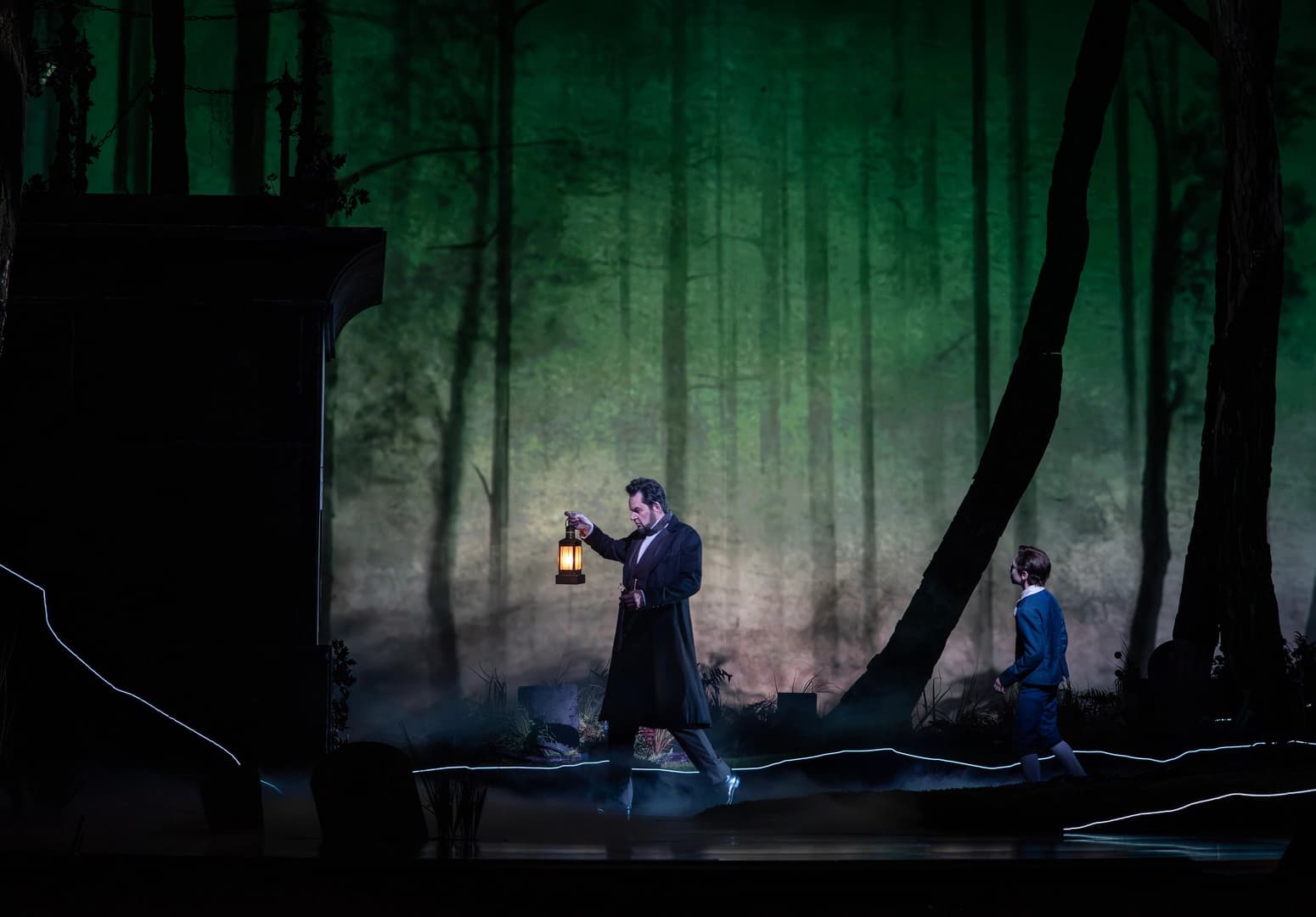
Peter Mattei as Lincoln and Everett Sobers as Willie Lincoln in Missy Mazzoli's "Lincoln in the Bardo."
Karen Almond / Met Opera
The opera takes place in February 1862. Abraham Lincoln has come to a Washington cemetery to mourn his eleven-year-old son, Willie, recently lost to typhoid fever. Outside the walls of the graveyard, the Civil War is tearing the country apart. Inside, a collection of restless spirits is engaged in its own existential struggle. These ghosts are stuck in the bardo, a transitional state between death and rebirth. There they linger, not realizing they're dead, and unable to move on. Each one is preoccupied with their unfinished stories: lost loves, old grievances, humiliations, disappointments…. They circle incessantly around the same memories, so absorbed in their own experiences and perspectives that they can barely acknowledge anyone else's.
How familiar.
We're a country of unfinished stories, all of us carrying our own ancestral and personal disappointments and fears, our private versions of what has happened to us and what we feel we've lost. We're burdened with the unfinished business of our collective history: dispossession, slavery, exclusion, and inequity. We're enmeshed in the never-ending struggle to reconcile the ambitions of our founding promise with the realities of the American experiment.
In conversations across the country, I've been struck by how differently people understand our shared American ideals. Liberty, for one person, can mean the freedom to pursue a dream; for another, the freedom to live without fear, or simply to be fully oneself. Last year in Philadelphia, I met a man named William whose interpretation of liberty has stayed with me. “Liberty is following your own path while celebrating those that others have chosen,” he said, “ knowing that our greatest allegiance is to each other, and that is our path to happiness.”
I've thought about William's words often. He didn’t describe liberty as something we possess individually, or something we defend against one another, but rather as a relationship, a responsibility to recognize and protect one another's humanity.
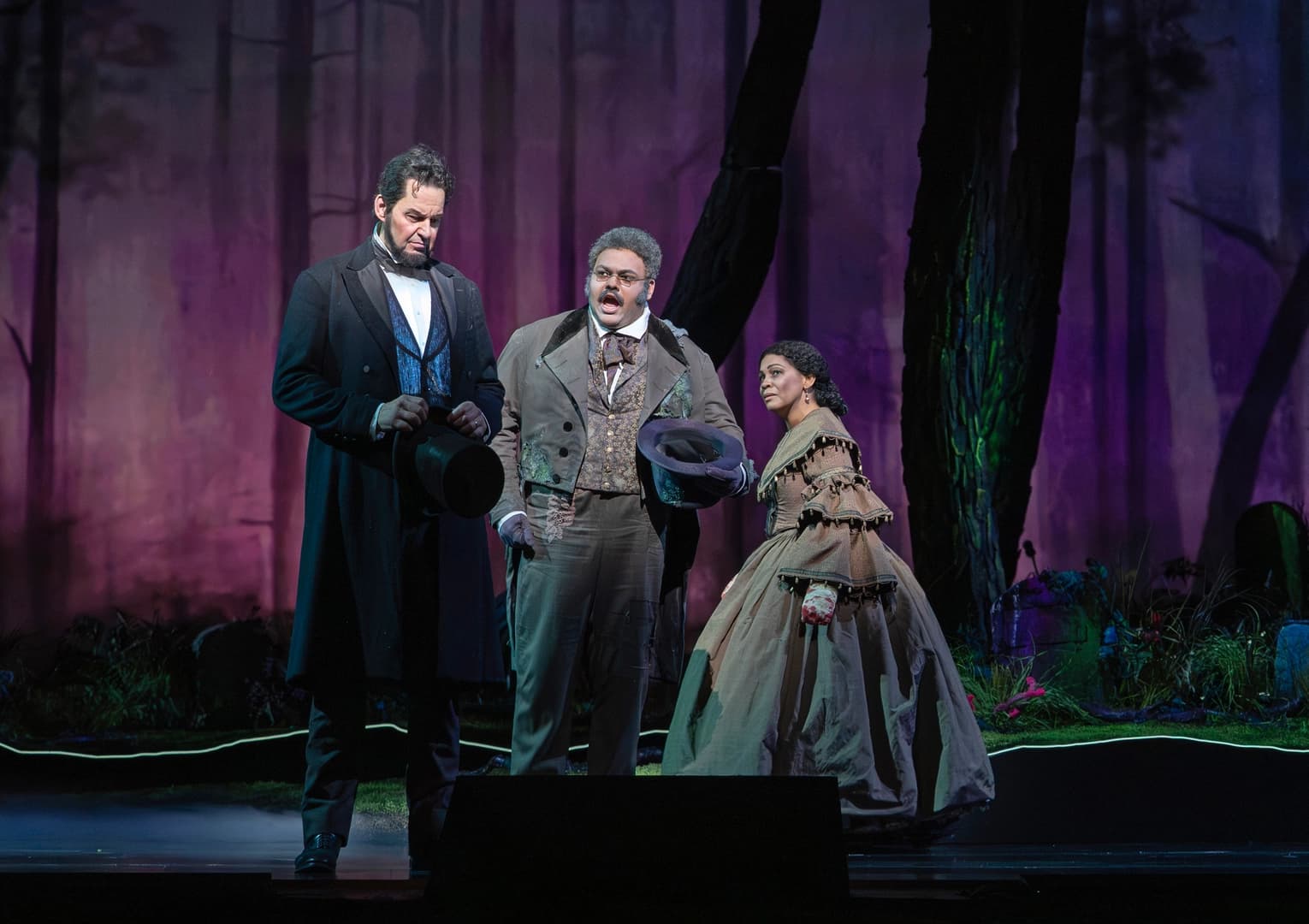
Peter Mattei as Lincoln, Joshua Blue as Thomas Havens, and Janai Brugger as Mrs. Francis Hodge in Missy Mazzoli's "Lincoln in the Bardo."
Karen Almond / Met Opera
The transformative moment in Lincoln in the Bardo comes when the graveyard spirits enter Lincoln's body together, inhabiting his consciousness and gaining access not only to his thoughts, but to one another's memories and experiences. For a moment, their separate lives become part of a shared consciousness, and Lincoln himself is changed by the voices he carries within him.
It's a powerful idea: that we might understand ourselves more fully by inhabiting someone else's experience. And as a musician, I find something deeply familiar in the notion of so many individual voices and histories becoming part of a shared consciousness.That’s what music has always been.
Mazzoli's score for this opera is broad and cinematic, full of sweeping gestures and moments of startling tenderness. But it's also restless and fragmented - musical phrases break off, rhythms collide, voices interrupt one another. Sometimes the orchestra seems to be pulling in several directions at once, as though the music itself can't quite decide where it belongs. It's an approach that evokes the distinctly American music of Charles Ives, who embraced the cacophony of public life: church hymns, marching bands, popular tunes, competing melodies drifting across a town square. He wasn't interested in making these sounds behave. He let them jostle and overlap, creating something unruly and authentically alive.
Maybe it's impossible for American music not to reflect the dissonances and syncopations of our national life. I've always loved that about our musical history. The blues, jazz, spirituals, folk songs, and countless traditions brought here from around the world tell stories of encounter and exchange, but also of displacement, resistance, and struggle.
In his “I Have a Dream” speech, Martin Luther King Jr. spoke of transforming the nation's “jangling discords” into a “beautiful symphony of brotherhood.” I wonder whether the beauty of that imagined symphony lies not in some final, perfect resolution, but in the work of reaching toward it. King's vision demanded action, courage, and profound change. It also held out the possibility that a country so deeply divided might learn to hear itself differently.
As a musician, I know that dissonance creates tension, movement, and transformation. Sometimes it resolves; sometimes it doesn't. Every unexpected combination of notes can change the direction of the music. In democracy, too, difference and disagreement are part of the design. We bring different histories, interests, convictions, and hopes into a shared political life. The tension between them gives democracy its energy, challenging us to negotiate our differences and shape decisions about our collective future.
With the midterm elections coming up tomorrow, I've been thinking about the distinction between disagreement and disengagement. There's something profoundly musical about the democratic process: the individual voice matters, but so does its relationship to every other voice in the chorus, every instrument in the symphony. Our participation requires us to recognize that our freedom to make ourselves heard is inseparable from the ability of others to do the same.
There's a phrase in the opera that comes directly from Saunders's novel: “Pause, cease, self-interrupt...”
Self-interrupt. What an extraordinary idea.
What would happen if we could interrupt our own certainty long enough to hear something unfamiliar? If we could recognize that the history someone else carries might change our understanding of our own, and allow an unexpected chord to change the direction of the music? In Lincoln in the Bardo, Lincoln is forever changed by the stories of the dead who inhabit him. And as he finds his own way back to the living, that collective consciousness guides his decisions, shaping the course of the Civil War and the future of the nation.
America has always existed in the bardo between its ideals and its realities, the stories we tell about ourselves and the histories we're still learning to confront. As we move forward, we have no choice but to carry our ghosts with us, and weave their voices into the music of our future.