articles / Robert Schumann
Saturday Morning Car Tunes: Robert Schumann
Fototeca Storica Nazionale/Getty Images
Bettmann/Getty Images
Listen to the episode!
Waiting for the other Schu to drop? This week, Robert's your mann.
Howdy, howdy, howdy! I’m Solomon Reynolds, and this is: Saturday Morning Car Tunes! This morning…
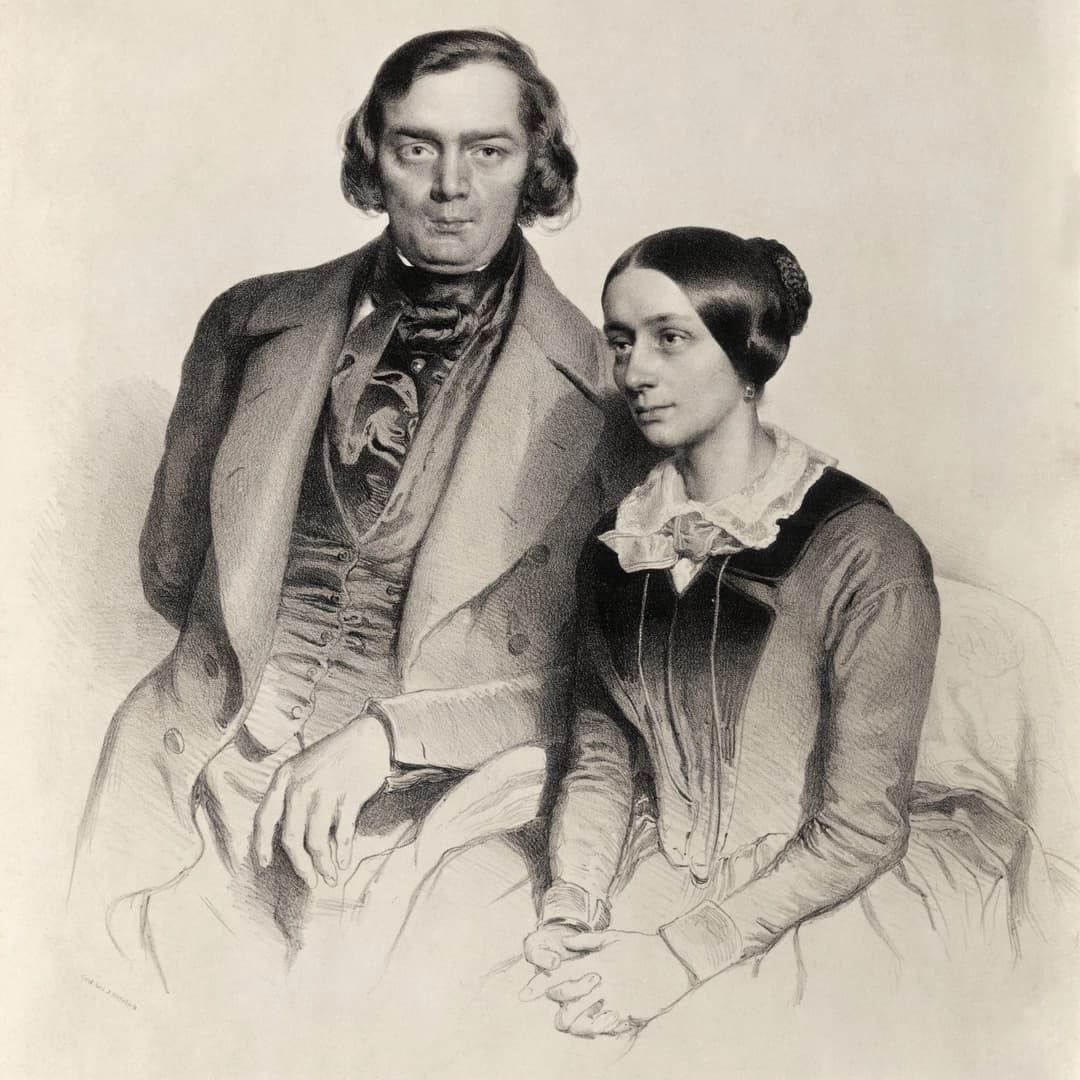
Robert Schumann is one of the greatest German Romantic composers—“Romantic” because his music was expressive and emotional, but also because it was inspired by love. Robert’s muse throughout his career was the concert pianist Clara Wieck, who later became his wife. Robert met Clara when he was 18, after moving in to study piano with her father, Friedrich Wieck. You’re listening to impromptus which Robert based on a theme by Clara.
Robert dreamed of becoming a virtuoso pianist like Liszt or Chopin, which might be why his piano music is so hard to play. But a finger injury led him toward composing instead. Clara, on the other hand, was one of Europe’s best pianists, and her concert tours introduced Robert’s music to the world. She premiered almost everything he wrote for piano. Even so, Clara asked him to rewrite the finale of his Piano Sonata No. 2, because it was “far too difficult.”
Their feelings grew for each other. Around the time he and Clara shared their first kiss and said, “I love you,” he wrote his Piano Sonata No. 3, which borrows an andantino from Clara.
When Robert was 27, he and Clara secretly became engaged. These were “the most blissful and purest days of [Robert’s] life.” As a sort of engagement present for Clara, Robert composed his Dances of the League of David, quoting one of her own mazurkas.
But Clara’s father refused to let them get married. He didn’t think Robert was good enough for his daughter. Robert wrote his Fantasy in C as a “deep lament for Clara.”
He loved her so much, it hurt. In his Novelettes, Robert echoes one of Clara’s nocturnes, as if it were a faraway voice.
To marry Clara, Robert had to take her father to court. Between court dates, he composed the last of a remarkable series of piano works spanning almost decade, all rooted in his relationship with Clara. This simple romance, which Clara called “the most beautiful love duet,” was a Christmas present to her.
The court finally granted Robert and Clara permission to marry. The year was 1840, which Robert called his “Year of Song.” He suddenly exploded into Lieder, or German art songs, writing over half his entire output in the genre. “How blissful it is to write for the voice!” he told Clara. As a wedding present, he gave her a song cycle, or a collection of songs that tells a story. “Dedication” is the best-known and was one of Clara’s favorites. I’m Solomon Reynolds. I write and produce Saturday Morning Car Tunes with research assistant Carolina Correa and audio engineer Stephen Page, only on Classical California. Tune in—or out of your car—next Saturday morning!